

Bài tập Tiếng Anh Lớp 8 - Unit 7
Put the verbs in brackete into the correct tense
1.If we ( recycle)……………. more, we (help).. ………… the earth.
2. Factoties ( not dump)…………. waste into the rivers if the government (fine) …………………. them heavy
3. If people (travel)…….. to work by bus, there (be) ………….. fewer cars fumes.
4. We ( save)………….. thousands of trees if we (not waste)…………….. paper.
5. If we ( use)……….. waste water carefully, more peope (have)……… fresh water.
6. If you (be)………. the president, what you(do)……………….?
7. they get sick so often. If they (exercise)………… more, they (be)……….. healthier.
8. If I ( have)………… one million US dolars, I (build)…….. more parks in our city.
9. Ngoc’s mother is unhappy. If Ngoc (tidy)…………….. her room every day, her mother (not be)……………………… so upset.
10. there isn’t a garden at our house. If there (be)….. , we ( grow)…….. vegetables.
 11 trang
17/06/2025
2000
11 trang
17/06/2025
2000
Tóm tắt nội dung tài liệu: Bài tập Tiếng Anh Lớp 8 - Unit 7
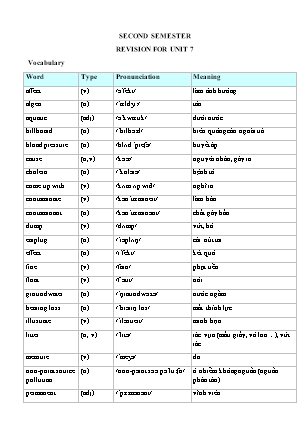
 SECOND SEMESTER
 REVISION FOR UNIT 7
Vocabulary
Word Type Pronunciation Meaning
affect (v) /əˈfekt/ làm ảnh hưởng
algea (n) /ˈældʒiː/ tảo
aquatic (adj) /əˈkwætɪk/ dưới nước
billboard (n) /ˈbɪlbɔːd/ biển quảng cáo ngoài trờ
blood pressure (n) /blʌd ˈpreʃə/ huyết áp
cause (n,v) /kɔːz/ nguyên nhân, gây ra
cholera (n) /ˈkɒlərə/ bệnh tả
come up with (v) /kʌm ʌp wɪð/ nghĩ ra
contaminate (v) /kənˈtæmɪneɪt/ làm bẩn
contaminant (n) /kənˈtæmɪnənt/ chất gây bẩn
dump (v) /dʌmp/ vứt, bỏ
earplug (n) /ˈɪəplʌɡ/ cái nút tai
effect (n) /ɪˈfekt/ kết quả
fine (v) /faɪn/ phạt tiền
float (v) /f əʊt/ nổi
groundwater (n) /ˈɡraʊndwɔːtə/ nước ngầm
hearing loss (n) /ˈhɪərɪŋ lɒs/ mất thính lực
illustrate (v) /ˈɪləstreɪt/ minh họa
litter (n, v) /ˈlɪtə/ rác vụn (mẩu giấy, vỏ lon), vứt
 rác
measure (v) /ˈmeʒə/ đo
non-point source (n) /nɒn-pɔɪnt sɔːs pəˈluːʃn/ ô nhiễm không nguồn (nguồn
pollution phân tán)
permanent (adj) /ˈpɜːmənənt/ vĩnh viễn point source (n) /pɔɪnt sɔːs pəˈluːʃn/ ô nhiễm có nguồn
pollution
poison (n, v) /ˈpɔɪzn/ chất độc, làm nhiễm độc
pollutant (n) /pəˈluːtənt/ chất gây ô nhiễm
radioactive (adj) /ˌreɪdiəʊˈæktɪv/ thuộc về phóng xạ
radiation (n) /ˌreɪdiˈeɪʃn/ phóng xạ
thermal (adj) /ˈθɜːml/ thuộc về nhiệt
untreated (adj) /ˌʌnˈtriːtɪd/ không được xử lý
visual (adj) /ˈvɪʒuəl/ thuộc về thị giác
Grammar
 I. Conditional sentences
1.Conditional sentence tpye 1
 a. The use
 Câu điều kiện loại 1: Thể hiện điều kiện có thể xảy ra ở hiện tại hoặc tương lai .Ta
có thể dùng can, may hoặc must thay cho will.
b. form
 If + S + V( present simple) , S + simple future ( will).
 If- clause Main clause
Or S + simple future ( will) , If + S + V( present simple)
Ex: If it is fine tomorrow, We will go on a picnic.
Ex:If you try harder, you can pass the exam easily.
2.Conditional sentence type 2
a. The use
 . Câu điều kiện loại 2 : thể hiện điều không có thực ở hiện tại hoặc tương lai ( ước
muốn ở hiện tại nhưng thực tế sẽ không xảy ra được)
b. form
 If + S + V( past simple) , S + would / could/ might + V( bare infinitive)
 If- clause Main clause
 or S + would/ could/ might + V( bare infinitive)+ if + S + V ( past simple) Ex: If I was/ were taller, I would become a pilot.
 If I was/ were you , I would see the doctor
* note : chúng ta có thể sủ dụng was and were với I / he/ she / it trong mệnh đề if
B EXERCISE
I. Match the two parts of each sentence and make them into one complete
conditional sentence type 1. You can put if at the beginning or in the middle of the
sentence
 A B
 • Earth gets warmer a.we have more cars
 • things change for the better
 • people fly less b.the factory treats its waste well
 • air pollution become worse in the c.the sea level rises
 city
 • we regret in the future d.carbon emissios are reduced
 • there is less water pollution
 e. we take action immediately
 f. we use too much enrergy now
II.Put the verbs in brackete into the correct tense
1.If we ( recycle). more, we (help)..  the earth.
2. Factoties ( not dump). waste into the rivers if the government (fine)
. them heavy
3. If people (travel).. to work by bus, there (be) .. fewer cars fumes.
4. We ( save).. thousands of trees if we (not waste).. paper.
5. If we ( use).. waste water carefully, more peope (have) fresh water.
6. If you (be). the president, what you(do).?
7. they get sick so often. If they (exercise) more, they (be).. healthier.
8. If I ( have) one million US dolars, I (build).. more parks in our city.
9. Ngoc’s mother is unhappy. If Ngoc (tidy).. her room every day, her
mother (not be) so upset.
10. there isn’t a garden at our house. If there (be).. , we ( grow).. vegetables.
III Match an If clause in A a with suitable main in B
 A B
 • If I were you, a.what would happen?
 • If Lan wasn’t ill,
 • If there were fewer cars on the road, • If people really cared about the b. I’d look for a new place to live.
 environment,
 c.she would join our tree planting activity.
 • If there was no fresh water in the
 world, d. there would be less pollution.
 e. they wouldn’t dump waste into the lake
IV. Give the correct form of these verbs.
1.If you (come).. here in Sping, You will have a chance to go to the village fair.
2. Your work wouldn’t be sucessful if you ( not try) hard.
3. If Hoa ( finish). the dress before Saturday, she’ll give it to you.
4. The child will die if nobody (send) him for a doctor.
5. If you (go).. away, please write to me.
6. If he ( do) his homework, he wouldn’t worried about his examination.
8. If she (not be).. busy, she could come to the party.
9. If I finished my homework in time, I (go). to the soccer game.
10. If I were you, I (not go) there.
11. If he started earlier, he (be)in time.
12. If it (not rain) ,I will go to the movies.
13. If it (not rain)., I would go to the movies.
14. What would you do if you ( be) rich?
15. Where will she go if she ( have)..a car?
16. If I see him , I (give) him a gift.
17. If I ( have).. his telephone number, I would give it to you.
18. If he ( not study). hard, he’d fail the final examination.
19. He would get fat if he (stop)smoking
20. If I (be) .. you, I (accept) ..that job
V. Make conditional sentences type 2 from the clues.
1.If / I / be/ you/ , I / plant / vegetables / garden
2.More / tourist / come / here / if / beach / be / cleaner.
3. What / happen / if / thre / be/ no / car / world? 4. If / I / be / his mother/ , I / ask / tidy/ room / every day.
5. If / there / be / no war, people / live / more / happy.
6. soil / not / be / so / polluted / if / farmers/ not use / much / chamical / fertilizer.
V. Write a conditional sentence type 2
1. People throw rubbish in the street. The street doesn’t look attactive.
-> . If people don’t throw rubbish in the street, it .
2. There are so many billboards in our ciy . People can enjoy the view.
->
3. There is so much light in the city at night, we can not see the starsclearly.
->..
4. we ture on the heater all the time. We have to pay three million dong for electricy a
mouth.
->
5. The karaoke bar makes so much noise almost every night. The residents complete to
its owner.
->
6. She has a headache after work every day. She works in a noisy office.
->
 REVISION UNIT8
Vocabulary
Word Type Pronunciation Meaning
Aborigines (n) /ˌæbəˈrɪdʒəniz/ thổ dân châu Úc
absolutely (adv) /ˈæbsəluːtli / tuyệt đối, chắc chắn
accent (n) /ˈæksent/ giọng điệu
awesome (adj) /ˈɔːsəm/ tuyệt vời
cattle station (n) / ˈkætl ˈsteɪʃn/ trại gia súc
ghost (n) /ɡəʊst/ ma
haunt (v) /hɔːnt/ ám ảnh, ma ám icon (n) /ˈaɪkɒn/ biểu tượng
kangaroo (n) /ˌkæŋɡəˈruː/ chuột túi
koala (n) /kəʊˈɑːlə/ gấu túi
kilt (n) /kɪlt/ váy ca-rô của đàn ông Scotland
legend (n) /ˈledʒənd/ huyền thoại
loch (n) /lɒk/ hồ (phương ngữ ở Scotland)
official (adj) /əˈfɪʃl/ chính thống/ chính thức
parade (n) /pəˈreɪd/ cuộc diễu hành
puzzle (n) /ˈpʌzl/ trò chơi đố
schedule (n) /ˈʃedjuːl/ lịch trình, thời gian biểu
Scots/ Scottish (n) /skɒts/ ˈskɒtɪʃ/ người Scotland
state (n) /steɪt/ bang
unique (adj) /juˈniːk/ độc đáo, riêng biệt
collapse (v) /kəˈlæps/ đổ, sập, sụp, đổ sập
Grammar
I . Present tenses
1. Present simple
 a. The use:
Thì hiện tại đơn thường được dùng để:
- Diễn tả sự viẹc thường xuyên xảy ra ở hiện tại
Ex: I go to work at 7.30
 • Diễn trả những thói quen, tập quán hay đặc tính
Ex: he often pays badminton every day
 • Diễn tả một chân lý hay sự thật hiển nhiên
EX: the Sun rises in the east and sets in the west
b. Form
 (+) S + V (-s/es) + O
 (-): S + don’t / doesn’t + V + O
(?) Do / does + S + V + O.? Yes, S + do / does
 No, S + don’t / doesn’t
 • adv: every day, always, usually, sometimes , often, never
2.Present continuous
a.The use
- Thì hiện tại tiếp diễn được dùng để:
- Chỉ một hành động, sự việc đang xảy ra tại thời điểm nói
VD : We are studying English now
 Tom is talking to Lan at the moment
Note: Thường có các trạng từ dùng kèm như : Now (bây giờ) ; at the moment ( ngay lúc
này) ; at present (lúc này), right now ( ngay bây giờ), at this time , look, listen .
b. Form
 (+) S + am/ is / are + V- ing + O
 - I am playing soccer now
 - He is playing soccer now
(-) S + am/ is / are + V- ing + 0
• I am not playing soccer now
• He is not playing soccer now
(?) Am / is / are + S + V-ing + 0 ?
 Yes, S + am / is / are
 No, S + am not / is not / are not.
Ex: : Are you playing soccer ?
 Yes, I am
 Is Mary singing an English song?
 No, she isn’t
3. Present perfect tense
a.The use:
- Diễn tả hành động xảy ra trong quá khứ kéo dài đến hiện tại để lại kết quả ở hiện (
thường dùng với for, since) Ex: We have learned English for 4 years.
- Để chỉ 1 hành động đã xảy ra hơn 1 lần hoặc lặp đi lặp lại trong quá khứ
 Ex: I have seen this film four times.
C) chỉ một hành động, một sự kiện đã xảy ra vào một thời điểm không rõ ràng trong quá
khứ.
 Ex: They have known each other.
- Để chỉ 1 hành động vừa mới hoàn tất (luôn đi với từ just)
- trong câu có các từ: already, yet, ever, never
 - Already ( đã ..rồi) đứng giữa have/ has và PII
 Ex: I have already done muy homwork.
 - Yet/ (not yet) ( chưa /vẫn chưa) dùng trong câu nghi vấn và phủ định đứng cuối
 câu.
 - Ever( bao giờ, đã từng): dùng trong câu nghi vấn
 Ex:Have you ever been to Ho Chi Minh city?
 - Never: dùng trong câu khảng định đứng giữa have/has và PII.
* . Note
 Những từ nhận biết thì hiện tại hoàn thành: Just, already, recently, lately, never,
 ever, yet, so far (cho đến nay), up to now ( cho đến bây giờ), before ( truớc đây), for,
 since, It’s the first/ second/ third/ four. times
2. Form
(+) S + have/has + PII
 Ex: She has gone to England since 2003
(-) S + have/has + not + PII
 Ex: Tom has not played tennis yet.
 I have not stopped learning English
(?) Have/has + S + PII .?
 Ex: Have you ever been to England?
 Yes, I have / No, I haven’t Has she bought a new car?
 Yes, she has/ no, she hasn’t
 Wh : Wh + have / has + S + PII ?
 What have you done recently?
 + Have: I , you , we, they , Ns
 + Has: he , she, it
 + PII : có 2 loại: V-ed và V ( past participle)
B. Exercises
I. complete the sentences with the correct form of the verbs (present simple ,
present continuous or present perfect)
1. new zealand ( be) divided into the North island and the South island.
2. America ( crelebrate).. Thanksgiving Day on the fouth Thursdady of November.
3. England , Scotland, Wales , and Northern Island together ( form). the
United Kingdom.
4. The state of Liberty in New York is a monument ( symbolise).. freedom.
5. There are about 750 million English speakers in the world, and this number
(increase).. fast.
6. the famous Syney Opera House (serve).. as an arts centre since 1973
II. Complte the sentences with the correct tense of the verbs in brackets
1.Auturmn in my home village is so beautiful. I love it when all the leaves
(turn). Red or yellow.
2.Look at the Kangaroo . it (hop).. on its hind legs
3.The USA( celebrate).. its Independence Day on July 4th.
4. The population of Auckland (increase).. to nearly one and half million
5. The Walt Disney studios, the famous movie company.(produce).
hundred cartoons for children
6. We (work). hard at the moment to prepare for our annual Cultural festival.
7. L:ondon ( have). a population of eight million people. 8. This Year we ( have). more international visitors coming to attend our
Music Festival.
9. The inut, or the Eskimos ( live). in the land of the Uas and Canada for
thousand of years
10. Polar bears (live).. in the Arcitic
11. This year, Our school ( celebrate) our thirtieth anniverary in September
12. Nick, I can hear music and voice. Are you having aparty?
 Yes, , Nicole and I ( celebrate).. our tenth wedding anniversity.
13. the legend monster of Loch Ness in Scotland (attract ).... million of visitors
 14. The sweet smell of flowers often . insects , specially bees
15. I always (enjoy).... the Little Creature Family Festival at Londan zoo.
It’s so much fun there.
16. I am sure he ( enjoy). his new electric toy train. He looks so happy.
III. Four of the underlined verbs in the passage are incorrect in tense. Find and
correct the mistakes
Califonia (1) is home to the most iconic theme park in the world- Disneyland. Over
670 million people (2) visit it since opened in 1995 , and the number (3) increases fast.
Different kinds of entertainment (4) are provided throught out the park. Mickey ‘s
soundsational Parade , the most popular event, (5) has celebrated music from famous
Disney films. In the parade, well- known Disney chacraters (6) march along the street,
either on floats or on foot. They (7) are dancing along with the music, greet visitors,
talk with children and pose for photos. Everybody (8) is welcome to join in the fun.
IV.Read and answer True or False
 Water pollution is the contamination of bodies of water such as lakes, rivers, oceans,
and groundwater ( the water beneath the Earth’s suface). It is one of the most serious
types of pollution.
 Water pollution can have many different causes. Factories dump industrial waste into
lakes and rivers. Farms using pesticides to kill insects and herbicides to kill weeds can
also lead to water pollution. These factors cause ‘point source’ pollutants from storm
water and the atmosphere result in ‘non-point source’ pollution.
 Water pollution can have dramatic effects . In many poor nations, there are frequent
outbreaks of cholera and other diseases because of people drinking unstreated water.
File đính kèm:
- bai_tap_tieng_anh_lop_8_unit_7.doc


