

Bài tập Tiếng Anh Lớp 8 - Unit 6: Folk tales
Complete the following sentences with prepositions of time: at, on, in if necessary.
1. I don’t like going out alone night
2. I’m afraid I can’t come to your birthday party Sunday.
3. What do you usually do the weekend?
4. Can you play football with us next Sunday?
5. We went to bed late last night.
6. They are leaving for Hue next Friday.
7. Will you be at home this evening?
8. I always feel relaxed the evening.
9. We went to Nha Trang last summer.
10. I won’t be out so long. I’ll be back ten minutes.
 9 trang
16/06/2025
2060
9 trang
16/06/2025
2060
Bạn đang xem tài liệu "Bài tập Tiếng Anh Lớp 8 - Unit 6: Folk tales", để tải tài liệu gốc về máy hãy click vào nút Download ở trên
Tóm tắt nội dung tài liệu: Bài tập Tiếng Anh Lớp 8 - Unit 6: Folk tales
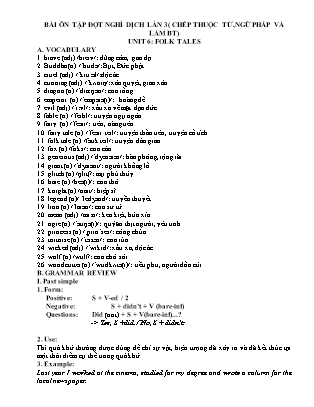
BÀI ÔN TẬP ĐỢT NGHỈ DỊCH LẦN 3( CHÉP THUỘC TỪ,NGỮ PHÁP VÀ LÀM BT) UNIT 6: FOLK TALES A. VOCABULARY 1. brave (adj) /breɪv/: dũng cảm, gan dạ 2. Buddha (n) /ˈbʊdə/: Bụt, Đức phật 3. cruel (adj) /ˈkruːəl/:độc ác 4. cunning (adj) /ˈkʌnɪŋ/: xảo quyệt, gian xảo 5. dragon (n) /ˈdræɡən/: con rồng 6. emperor (n) /ˈempərə(r)/: hoàng đế 7. evil (adj) /ˈiːvl/: xấu xa về mặt đạo đức 8. fable (n) /ˈfeɪbl/: truyện ngụ ngôn 9. fairy (n) /ˈfeəri/: tiên, nàng tiên 10. fairy tale (n) /ˈfeəri teɪl/: truyện thần tiên, truyện cổ tích 11. folk tale (n) /fəʊk teɪl/: truyện dân gian 12. fox (n) /fɒks/: con cáo 13. generous (adj) /ˈdʒenərəs/: hào phóng, rộng rãi 14. giant (n) /ˈdʒaɪənt/: người khổng lồ 15. glitch (n) /ɡlɪtʃ/: mụ phù thủy 16. hare (n) /heə(r)/: con thỏ 17. knight (n) /naɪt/: hiệp sĩ 18. legend (n)/ ˈledʒənd/: truyền thuyết 19. lion (n) /ˈlaɪən/: con sư tử 20. mean (adj) /miːn/: keo kiệt, bủn xỉn 21. ogre (n) /ˈəʊɡə(r)/: quỷ ăn thịt người, yêu tinh 22. princess (n) /ˌprɪnˈses/: công chúa 23. tortoise (n) /ˈtɔːtəs/: con rùa 24. wicked (adj) /ˈwɪkɪd/: xấu xa, độc ác 25. wolf (n) /wʊlf/: con chó sói 26. woodcutter (n) /ˈwʊdkʌtə(r)/: tiều phu, người đốn củi B. GRAMMAR REVIEW I. Past simple 1. Form: Positive: S + V-ed / 2 Negative: S + didn’t + V (bare-inf) Questions: Did (not) + S + V(bare-inf)...? ̵ > Yes, S +did. / No, S + didn’t. 2. Use: Thì quá khứ thường được dùng để chỉ sự vật, hiện tượng đã xảy ra và đã kết thúc tại một thời điểm cụ thể trong quá khứ. 3. Example: Last year I worked at the cinema, studied for my degree and wrote a column for the local newspaper. II. Past continuous: 1. Form: Positive: S + was / were + V-ing Negative: S + wasn’t / weren’t + V-ing Questions: Was / Were (not) + S + V-ing ...? ̵ > Yes, S +was/ were. / No, S + wasn’t/ weren’t. 2. Use: Thì quá khứ tiếp diễn được dùng để chỉ sự vật, hiện tượng đã xảy ra ở một thời điểm cụ thể trong quá khứ hoặc một khoảng thời gian không xác định trong quá khứ. Example: - It happened at five in the afternoon while he was watching the news on TV. - He was doing his homework in his bedroom when the burglar came into the house TEST 1 UNIT 6 I. Choose the word which has a different sound in the part underlined. 1. A. school B. architect C. change D. chemical 2. A. buffalo B. minority C. gold D. close 3. A. end B. pencil C. open D. bench 4. A. wanted B. washed C. watched D. stopped 5. A. remote B. explore C. relax D. diverse II. Choose the words that have the different stress from the others. 1. A. reflect B. fable C. spindle D. legend 2. A. ancestor B. origin C. stepmother D. continue 3. A. capture B. granny C. command D. swallow 4. A. rescue B. religion C. servant D. tortoise 5. A. emperor B. woodcutter C. announce D. suddenly III. Complete the following sentences with prepositions of time: at, on, in if necessary. 1. I don’t like going out alone night 2. I’m afraid I can’t come to your birthday party Sunday. 3. What do you usually do the weekend? 4. Can you play football with us next Sunday? 5. We went to bed late last night. 6. They are leaving for Hue next Friday. 7. Will you be at home this evening? 8. I always feel relaxed the evening. 9. We went to Nha Trang last summer. 10.I won’t be out so long. I’ll be back ten minutes. IV. Choose the correct answers. 1. Alice saw/ was seeing the accident when she was catching the bus. 2. What were you doing/ did you do when I called? 3. I didn’t visit/ weren’t visiting my friends last summer holiday. 4. It rained/ was raining heavily last July. 5. While people were talking to each other, he read/ was reading his book. 6. My sister was eating/ ate hamburgers every weekend last month. 7. While we were running/ run in the park, Mary fell over. 8. Did you find/ Were you finding your keys yesterday? 9. Who was she dancing/ did she dance with at the party last night? 10.They were watching/ watched football on TV all day. V. Find the mistakes. 1. I was play football when she called me. ....................................................................................... 2. Was you study Math at 5 p.m. yesterday? ....................................................................................... 3. What was she do while her mother was making lunch? ....................................................................................... 4. Where did you went last Sunday? ....................................................................................... 5. They weren’t sleep during the meeting last Monday. ....................................................................................... 6. He got up early and have breakfast with his family yesterday morning. ....................................................................................... 7. She didn’t broke the flower vase. Tom did. ....................................................................................... 8. Last week my friend and I go to the beach by bus. ....................................................................................... 9. While I am listening to music, I heard the doorbell. ....................................................................................... 10.Peter turn on the TV, but nothing happened. ....................................................................................... VI. Put the verb in correct tense or form. 1. Trung’s father (teach) him how (ride) a bicycle when he (be) twelve years old. 2. How your brother (go) to work everyday? - He usually (drive). 3. We (go) to Ha Long Bay this weekend. 4. You (use) to play so much when you (live) in the countryside? 5. Yesterday Hoang (spend) two hours (repair) his computer set. VII. Put the correct verb form of the past tenses. In my last holiday, I went to Hawaii. When I (go) 1 ........................ to the beach for the first time, something wonderful happened. I (swim) 2 ........................ in the sea while my mother was sleeping in the sun. My brother was building a castle and my father (drink) 3 ........................ some water. Suddenly I (see) 4 ........................ a boy on the beach. His eyes were blue like the water in the sea and his hair (be) 5 ........................ beautiful black. He was very tall and thin and his face was brown. My heart (beat) 6 ........................ fast. I (ask) 7 ........................ him for his name with a shy voice. He (tell) 8 ........................ me that his name was John. He (stay) 9 ........................ with me the whole afternoon. In the evening, we met again. We ate pizza in a restaurant. The following days we (have) 10 ........................ a lot of fun together. At the end of my holidays when I left Hawaii I said good-bye to John. We had tears in our eyes. He wrote to me a letter very soon and I answered him. VIII. Read the following passage, answer/ complete the questions/ statements below it. Once, there was a boy named Boly. He lived with his aged grandmother in Kanchi Village. His grandmother always woke up very early in the morning and made little buns and cakes. She sold them in the market place. With the money she earned, she sent Boly to school. Boly was a good boy. He was an orphan. He loved his grandmother a lot. After school, he always went home quickly. Then, he would have his lunch and do his homework. In the evenings, Boly would go round the village selling the cakes his grandmother made. Boly and his grandmother lived quite happily. One day, Boly’s grandmother fell ill. She could not make any more cakes. Boly now had to look for work. He went from house to house doing odd jobs. It was in one of these houses that a kind gentleman asked Boly why he was working at such a tender age. After listening to Boly’s story, the man said that he wanted to adopt Boly. He was willing to take care of Boly’s grandmother too. From then on, Boly and his grandmother led a very happy life. 1. The phrases of words “very old” is similar to the word ......................... in the text. 2. Boly was living with his grandmother because...................................................... ................................................................................................................................ 3. Boly’s grandmother could afford to send him to school by .................................. 4. After school, Boly would immediately .................................................................. 5. Boly had to look for work because......................................................................... IX. Answer the following questions, using the suggested words or phrases in brackets. Example: Where did the children go after the lesson? (the park) They went to the park after the lessons. 1. When did you begin learning English? (three years ago) => ....................................................................................... 2. How many exercises did you do last night? (four exercises) => ....................................................................................... 3. What time did the man telephone his wife? (at two o’clock) => ....................................................................................... 4. How many years was Mr. Green in Viet Nam? (for ten years) => ....................................................................................... 5. What time did you get up this morning? (half past five) => ....................................................................................... 6. What did you have for breakfast this morning? (bread and omelets) => ....................................................................................... 7. What time did you leave home? (six o’clock) => ....................................................................................... 8. How did you go to school this morning? (by bicycle) => ....................................................................................... 9. What did you do after your homework last night? (watch television) => ....................................................................................... 10.What time did you go to bed last night? (at ten o’clock) => ....................................................................................... X. Rewrite the sentences, using “the past continuous” and “while” or “when”. 1. We were having dinner and they were listening to the radio. We were ........................................................................ 2. She was sleeping and the fire started. The fire ......................................................................... 3. It began to rain and what were you doing? What ............................................................................. 4. The farmer started whistling and he was ploughing the field. When ............................................................................ 5. You came and what were they doing? What ............................................................................. 6. She came and what was happening? What was ...................................................................... 7. She was reading a book and the man came in. The man......................................................................... 8. They were working in the field and the volcano erupted. The volcano .................................................................. 9. The ship was leaving the harbor and the lava hit the town. The lava ........................................................................ 10.The headmaster was going to his car and someone hit him on the head. Someone hit the headmaster ......................................... TEST 2 (UNIT 6) I.Choose the best answer A, B, C or D to complete the sentences. 1.The toad was very because he tried to find way to the heaven to sue God.. A.braveB.kind C.generousD.mean 2.The King was very to allow his daughter, Tien Dung, to travel to the many wonderful places of the kingdom. A.wiseB.mean C.kindD.wicked 3.The Peacock was well known to be a/an animal, so he just applied black colour to the Crow's feathers. A.hard-workingB.lazy C.uglyD.clever 4.The wife of the fisherman was very when she demanded for bigger and bigger things. A.kindB.generous C.greedyD.fierce 5.Ali Baba was very when he also used the words "Open Sesame!" to enter cave of treasures. A.wiseB.cunning C.kindD.evil 6.The servant was very to mark other houses with white chalk so that the thieves couldn't find Ali Baba's house. A.meanB.wicked C.kindD.Clever II. Choose the best answer A, B, C or D complete the sentences. 1. ThachSanh was very when he let Ly Thong and his mother go back to their hometown. A. selfish B. mean C. generous D. brave 2.The ogre was so , and was a to catch ThachSanh with its sharp claws. A. fierce B. mean C. cleverD. ugly 3. ThachSanh was so that he could push back the troops with his magical rice pot. A. kind B. clever C. hard-working D. fast 4. An Tiem was very to move to a deserted island. A. braveB. honest C. kind D. generous 5. Khoai was very , but his landowner was . A. lazy - cunning B. clever - braveC.honest - wiseD. honest - cunning 6. Tam was a very girl who had to work all day. A. mean B. generous C. hard-working D. lazy 7.Cam was very when she killed the nightingale, cooked it and threw the feathers in the Imperial Garden. A. wicked B. ugly C. honest D. mean 8. LuuBinh was very to invite Duong Le to come and live with him. A. selfishB. kind C. mean D. brave III.Put the verbs in brackets into the Past Simple or Past Continuous tense. 1. Last night I (read) when suddenly I (hear) a shout. 2. The postman (come) while while I (have) lunch. 3. When we (go) out, it (rain). 4. (you/ watch) TV when I (phone) you? 5. We (meet) Ann at the party yesterday, she (wear) a lovely white dress. 6. The boys (break) the window while they (play) football 7. I was home late, but my friends (wait) when I (arrive) . 8.He said that he (not drive) fast when the accident (happen) . 9.Tom (fall) off the ladder while he (paint) the ceiling. 10.What (you/do) at this time yesterday? IV.Put the verbs into the correct form, the Past Continuous or Simple Past. 1. When I last (see) them, they (try) to find a new flat near the office. 2. I (walk) along the street when l suddenly (feel) something hit me in the back. 3. When we (drive) down the hill, a strange object (appear) in the sky. 4. How fast (she/drive) when the accident (happen) ? 5. My mother (wait) for me when I (come) home. 6.Mrs. Smith (invite) Mrs. Quyen to have dinner while Mrs. Quyen(visit) the USA. 7. I (not want) to go with him because I (wait) for a phone call. 8. The doorbell (ring) while Tom (watch) TV. 9. It suddenly (begin) to rain while Linda (sit) in the garden. 10. The lights (go) out while we (have) dinner. V. Put the verbs in brackets into the Past Simple or Past Progressive tense. 1. When my uncle (come) ,we (water) the plants and flowers in the garden. 2. Thu (talk) to her friend, Hoa, on the phone at 8 o'clock last night. 3. Lan (practise) the piano while her sister (read) comics at 7 o'clock last night. 4.The monkeys (climb) up the trees when we (visit) the zoo yesterday morning. 5. Ba (talk) with his classmate when the principal (enter) their classroom. 6. Last night I (make) a cake when the lights (go) out. 7. While I (cross) the street,I (step) on a banana skin and (fall) heavily. 8.It (begin) to rain when I (plant) some flowers in the garden. 9.When I (arrive) , the teacher (write) on the blackboard. 10. When they (walk) down the stairs, they (hear) a strange noise. VI. Complete the sentences with verbs in brackets in the past continuous. Last Saturday, we were very busy. In the morning, ... 1. I (do) my homework 2. my parents (shop) . 3. my sister (chat) to her friends online. 4. my grandparents (drive) to our house. At two o'clock in the afternoon, ... 5. I (make) tea for everyone. 6. my sister and my mum (cook) dinner. 7. my grandmother (sleep) in front of the TV. At five o'clock in the afternoon, 8. we (have) a snack. At six o'clock in the evening, 9. my parents and my grandmother (drink) tea. 10. my grandfather (try) to send an e-mail on my computer. VII. Read this fable, and choose the correct answer A, B, C or D for each gap. Wisdom A farmer was ploughing his field. Sometimes, he shouted at and beat the buffalo that was (1) the plough. A tiger happened to stroll along the edge of the field. "Buffalo, you are so big. (2) do you let this weak man beat you?”, he asked. The buffalo answered, "The man is small (3) his wisdom is big.” The tiger did not understand what wisdom was (4) he shouted at the man. "Hey you, man, what is wisdom? Let me see it." "Wisdom? Oh, my wisdom (5) at home”, replied the man, looking at the tiger's teeth and claws. “Go home (6) get it. Bring it here so that l can see it”, the tiger ordered. "Oh, no! I am afraid that you will eat my buffalo (7) I am gone. (8) youagree to be tied with rope. I will run home and fetch my wisdom.” The tiger agreed. (9) fastening the tiger, the farmed beat its back. “(10) is my wisdom. This is my wisdom", he explained. 1.A.pullB.pulling C.pulledD.to pull 2.A.WhatB.How C.WhenD.Why 3.A.andB.but C.soD.or 4.A.andB.but C.althoughD.so 5.A.isB.are C.wasD.were 6.A.butB.and C.soD.yet 7.A.whyB.while C.althoughD.if 8.A.WhileB.Because C.AlthoughD.If 9.A.BeforeB.After C.BecauseD. But 10.A.HereB.There C.SheD.That VIII.Read the following passage, and then answer the questions. Once upon a time, there was a girl called Cinderella who did all the work in the kitchen while her lazy sisters did nothing. One night her sisters went to a ball at the palace. Cinderella was left at home, feeling very sad. After a time her fairy godmother appeared and told Cinderella that she could go to the ball, but she had to return home by midnight. So she went to the ball in a beautiful dress and a wonderful coach. She danced with the prince, but at midnight she ran back home, leaving one of her shoes on the dance floor. The prince wanted to see her again and went to every house in the capital until he found that the shoe was the right size for Cinderella. The prince and Cinderella were married and lived happily ever after. 1. Where did Cinderella's sisters go one night? ________________________________________________________________________ 2. How was Cinderella when she was left at home? ________________________________________________________________________ 3. Who appeared and helped Cinderella? ________________________________________________________________________ 4. What did Cinderella do at the ball ________________________________________________________________________ 5. What was the end of the story? ____________________________________________ IX. Read this legend, and choose the correct answer A, B, C or D for each gap. Lac Long Quan and Au Co (Origins of the Vietnamese) Once upon (1) ,in the land called Lac Viet, Lac Long Quan, the dragon king of the ocean, lived (2) and sometimes turned to the land to help people fight against demons, (3) them to grow rice and cut wood for building houses. Lac Long Quan(4)______ Au Co - the daughter of Agriculture Saint. The couple livedin harmony in a palace. Later, Au Co gave birth to a one-hundred-egg bag, hatching to 100 sons. One day, Lac Long Quan (5) that he couldn’t live (6)_______ the land all the time. He took so 50 of their sons settle down into the sea. The rest (7)___--- Au Co to go up to the mountain. Although the separated, they remembered to helpand protect (8) in need. The oldest son, who followed the mother with 49 brother, (9) King Hung. He set up his capital in PhongChau and gave his country the name Van Lang. From the story, the Vietnamese (10) always proud of the noble origin: dragon’s children and fairy’s grandchildren. 1.A.timeB.a time C.the timeD.times 2.A.on waterB.on the water C.under waterD.under the water 3.A.teachB.ask C.learnD.make 4.A.got married withB.got married C.marriedD.married with 5.A.was believedB.was thought C.consideringD.felt 6.A.atB.on C.inD.under 7.A.followB.following C.followedD.were followed 8.A.otherB.each other C.anotherD.others 9.A.becomeB.becoming C.was becomingD.became 10.A.isB.are C.wasD.were
File đính kèm:
- bai_tap_tieng_anh_lop_8_unit_6_folk_tales.docx


