

Bài tập ôn tập Tiếng Anh Lớp 8 - Unit 7+8
Usage (Cáchdùng)
- Thì hiện tại đơn diễn tả thói quen hằng ngày.
EgHe gets up at 5 o’clock in the morning.
-Thì hiện tại đơn diễn tả sự việc hay sự thật hiển nhiên.
EgWe have two children.
-Thì hiện tại đơn diễn tả sự việc xảy ra trong tương lai theo thời gian biểu hay lịchtrình.
EgThe plane takes off at 5.00 tomorrow morning.
 15 trang
17/06/2025
1980
15 trang
17/06/2025
1980
Bạn đang xem tài liệu "Bài tập ôn tập Tiếng Anh Lớp 8 - Unit 7+8", để tải tài liệu gốc về máy hãy click vào nút Download ở trên
Tóm tắt nội dung tài liệu: Bài tập ôn tập Tiếng Anh Lớp 8 - Unit 7+8
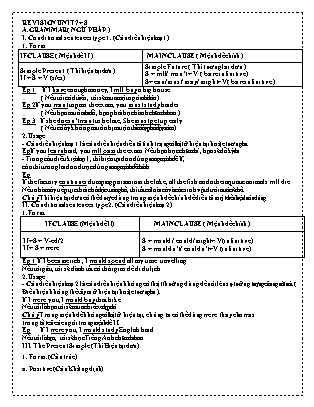
 REVISION UNIT 7+ 8
A.GRAMMAR ( NGỮ PHÁP )
I. Conditional sentences type 1. (Câuđiềukiệnloại 1)
1. Form
IFCLAUSE ( Mệnhđề If ) MAIN CLAUSE ( Mệnhđềchính )
 Simple Future ( Thì tương lai đơn )
Simple Present ( Thìhiệntạiđơn )
 S + will/ won’t + V ( bare infinitive )
If + S + V (s/es)
 S+ can/must/ may/ might+ V( bare infinitive )
Eg 1 If I have enough money, I will buy a big house.
 ( Nếutôicóđủtiền , tôisẽmuamộtngôinhàlớn ).
Eg 2If you want to pass the exam, you must study harder.
 ( Nếubạnmuốnthiđỗ , bạnphảihọchànhchămchỉhơn ).
Eg 3 If she doesn’t want to be late, She must get up early.
 ( Nếucôấykhôngmuốnbịmuộnthìcôấyphảidậysớm ).
2.Usage
- Câuđiềukiệnloại 1 làcâuđiềukiệndiễntảtìnhtrạngcóthật ở hiệntạihoặctươnglai.
EgIf you learn hard, you will pass the exam. Nếubạnhọcchămchỉ , bạnsẽđỗkỳthi.
- Trongcâuđiềukiệnloại 1, thìhiệntạiđơndùngtrongmệnhđề If,
cònthìtươnglaiđơnđượcdùngtrongmệnhđềchính.
Eg
If the factory continues dumping poison into the lake, all the fish and other aquatic animals will die
Nếunhàmáytiếptụcthảichấtđộcxuốnghồ, thìtấtcảloàicávàcácsinhvậtdướinướcsẽchết.
Chú ýThìhiệntạiđơncóthểđượcdùngtrongmệnhđềchínhđểdiễntảmộtđiềukiệnluônđúng
II. Conditional sentences type 2. (Câuđiềukiệnloại 2)
1.Form.
 IFCLAUSE (Mệnhđề If) MAIN CLAUSE ( Mệnhđềchính )
If +S + V-ed/2 S + would / could/might + V(infinitive)
If + S + were S + wouldn’t / couldn’t +V (infinitive)
Eg 1 If I became rich , I would spend all my time travelling.
Nếutôigiàu, tôi sẽ dành tất cả thời gian để đi du lịch.
2.Usage
- Câuđiềukiệnloại 2 làcâuđiềukiệnkhôngcóthậtthườngdùngđểnóilênsựtưởngtượngcủangườinói. (
Điềukiệnkhôngthểxảyra ở hiệntạihoặctươnglai ).
If I were you, I would buy that bike.
Nếutôilàbạntôisẽmuachiếcxeđạpđó.
Chú ýTrongmệnhđềkhôngcóthật ở hiệntại, chúng ta cóthểdùng were thaycho was
trongtấtcảcácngôitrongmệnhđề If.
Eg If I were you, I would study English hard.
Nếutôilàbạn, tôisẽhọcTiếngAnhchămchỉhơn.
III. The Present Simple (ThìHiệntạiđơn )
1. Form. (Cấutrúc)
a. Positive (CâuKhẳngđịnh) I / We / You / They + V( nguyênmẫu)
 He / She / It + V (s/es)
Eg I go to school every day.
 My father often watches TV at 7 p.m
b. Negative (CâuPhủđịnh)
 I / We / You / They don't (do not)+ V (nguyênmẫu)
 He/ She / It doesn't (does not) + V (nguyênmẫu)
EgI don’t go to school on Sundays.
 He doesn’t play games on Saturdays.
c. Question (Câunghivấn)
 Do I / We / You / They + V (nguyênmẫu)
 Does He/ She / It + V (nguyênmẫu)
EgDo you go to school every day ?
 Does he play football every afternoon?
2. Usage (Cáchdùng)
- Thìhiệntạiđơndiễntảthóiquenhằngngày.
EgHe gets up at 5 o’clock in the morning.
-Thìhiệntạiđơndiễntảsựviệc hay sựthậthiểnnhiên.
EgWe have two children.
-Thìhiệntạiđơndiễntảsựviệcxảyratrongtươnglaitheothờigianbiểu hay lịchtrình.
EgThe plane takes off at 5.00 tomorrow morning.
+ Cáctrạngtừđikèmvớithìhiệntạiđơn
 - Every day / week / month..(Hằngngày / tuần / tháng...)
 - Always : luônluôn
 - Usually : thườngxuyên
 - Often : thường
 - Sometimes : thỉnhthoảng
 - Seldom : hiếmkhi
 - Never : khôngbaogiờ NOTE (CHÚ Ý)
 - Nhữngđộngtừtậncùnglà : o, s , ch , sh, x, z , ta thêmes
 Eg go -> goes
 watch -> watches
 wash -> washes
 fix -> fixes
 - Nhữngđộngtừtậncùnglà y màđằngtrướclànguyênâm ( u, e ,o , a, i) ta đểnguyên y rồithêm s
Eg play ->plays
say -> says
 - Nhữngđộngtừtậncùnglà y màđằngtrướclàphụâm ta đổi y thành i rồithêmes
 Egstudy -> studies
 fly -> flies
IV. The Present Continuous (Thìhiệntạitiếpdiễn)
1. Form (Cấutrúc)
a. Câukhẳngđịnh
 I + am + V-ing
 He / She / It + is + V-ing
We / You / They + are + V-ing
Eg I am learning English at the moment.
 He is playing football now.
 We are listening to music at this time.
b. Câuphủđịnh
 I + am + not + V-ing
 He / She / It + is + not + V-ing
We / You / They + are + not + V-ing
Eg I am not learning English at the moment.
 He is not playing football now.
c. Câunghivấn.
 Am + I + V-ing Is + He / She / It + V-ing
 Are + You / We / They + V-ing
Eg
Are you learning English at the moment?
Is He playing football now ?
2. Usage. (Cáchdùng)
-Thìhiệntạitiếpdiễndùngđểdiễntảmộthànhđộngđangxảyratạithờiđiểmnóitronghiệntại.
Eg She is talking to her teacher about that plan.
- Thìhiệntạitiếpdiễnđềcậpđếnnhữngthóiquenxấugâykhóchịuchongườikhác, thườngđicùngtrạngtừ “
always “ hoặc “constantly”.
EgHe is always leaving his dirty socks on the floor.
- Thìhiệntạitiếpdiễndùngđểdiễntảnhữngtìnhhuốngđangthayđổi.
Eg Her son is getting better.
-Thìhiệntạitiếpdiễndiễntảmộtkếhoạchchắcchắnsẽxảyratrongtươnglai
(thườngđicùngvớitrạngtừchỉthờigiantrongtươnglai).
Eg. I am studying English next summer.
Cáctrạngtừđikèmvớithìhiệntạitiếpdiễn.
 - Now : bâygiờ
 - At the moment : ngaybâygiờ
 - At this time : vàolúcnày
 - Today : hôm nay
 - Be quiet : Hãyyênlặng
 - Listen : Nghenày
V. The Present Perfect (Hiệntạihoànthành)
1. Form (Cấutrúc)
a. Câukhẳngđịnh
 I /You/ We/ They + have + Ved / Vpp
 He / She / It + has + Ved /Vpp
EgI have lived in ThanhHoa city since 1987
 He has bought a new car for 2 weeks.
b. Câuphủđịnh
 I /You/ We/ They + have + not + Ved / Vpp He / She / It + has + not + Ved /Vpp
EgI haven’t lived in ThanhHoa city since 1987
 He hasn’t bought a new car for 2 weeks.
c. Câunghivấn
 Have + I /You/ We/ They + Ved / Vpp
 Has + He / She / It + Ved /Vpp
EgHave you been to England ?
Has Ba goneto Sam Son beach?
2. Usage (Cáchdùng).
- Thìhiệntạihoànthànhdiễntảsựviệcxảyratrongquákhứvàkéodàiđếnhiệntại.
EgI have learnt English for 15 years.
 She has lived here since 2016
- Thìhiệntạihoànthànhdiễntảsựviệcvừamớixảyranhưngkhôngđềcậpđếnthờigian
,thườngdùngvớicáctừnhư “ just, already hay yet.
 Eg She has just come.
 They haven’t arrived yet.
-Thìhiệntạihoànthànhdùngđểnóivềcácsựviệcvừamớixảyravàhậuquảcủanóvẫncònảnhhưởngđếnhiệntại.
Eg He has just washed his car, so it looks very clean now.
-Thìhiệntạihoànthànhkhinóivềtrảinghiệm hay kinhnghiệm , thườngđikèmvới ever/ never.
EgHave you ever been to London ?
Ihave never seenthat movie before.
Nhữngtrạngtừchỉthờigianđikèmvớithìhiệntạihoànthành:
 - Ever : baogiờ
 - Never : khôngbaogiờ
 - So far : chođếnbâygiờ / nay
 - Serveral times : vàilầnrồi
 - Just : vừamới’
 - Already : rồi
 - Yet : chưa
VI. The present simple for future.( Thìhiệntạiđơnmang ý nghĩatươnglai)
1. Form. (Cấutrúc)
a. Positive (CâuKhẳngđịnh) I / We / You / They + V( nguyênmẫu)
 He / She / It + V (s/es)
Eg I go to school every day.
 My father often watches TV at 7 p.m
b. Negative (CâuPhủđịnh)
 I / We / You / They don't (do not)+ V (nguyênmẫu)
 He/ She / It doesn't (does not) + V (nguyênmẫu)
EgI don’t go to school on Sundays.
 He doesn’t play games on Saturdays.
c. Question (Câunghivấn)
 Do I / We / You / They + V (nguyênmẫu)
 Does He/ She / It + V (nguyênmẫu)
EgDo you go to school every day ?
 Does he play football every afternoon?
2. Usage (Cáchdùng)
- Thìhiệntạiđơndiễntảthóiquenhằngngày.
EgHe gets up at 5 o’clock in the morning.
-Thìhiệntạiđơndiễntảsựviệc hay sựthậthiểnnhiên.
EgWe have two children.
Ngoàicáchdùng ở trên , thìhiệntạiđơncònmang ý nghĩatươnglaikhinóivềthờigianbiểu,
chươngtrình , lịchtrình ,  vàtrongcáctrạngtừchỉthờigiancụthể..
EgThe plane takes off at 5.00 tomorrow morning. B.EXERCISE (BÀI TẬP)
PHONETICS
Question I. Find the word which has different sound in the part underlined.
1. A. wanted B. washed C. danced D. played
2. A. goes B. watches C. misses D. brushes
3. A. come B. mother C. open D. some
4. A. mention B. question C. action D. education
5. A. who B. when C. where D. what
Question II.Find the word which has different sound in the part underlined.
1.A. sun B. fun C. put D. unhappy
2. A. mind B. bike C. tradition D. tidy
3. A. my B. happy C. hobby D. factory
4.A. health B. team C. tea D. beach
5.A. listened B. opened C. wanted D. lived
Question III. Find the word which has different stress pattern from the others.
1.A. person B. father C. teacher D. enjoy
2. A. prefer B. enjoy C. mother D. agree
3.A. doctor B. father C. picture D. begin
4.A. pollution B. visit C. listen D. open
5.A. depend B. advise C. affect D. listen
Question IV. Find the word which has different stress pattern from the others.
1.A. affect B. father C. teacher D. picture
2. A. prefer B. enjoy C. mother D. affect
3.A. affect B. happen C. pollution D. fancy
4.A. pollution B. picture C. village D. factory
5.A. illustrate B. believe C. affect D. village
Question V. Find the word which has different stress pattern from the others.
1. A. artistic B. historic C. dramatic D. scientific
2. A. medical B. national C. chemical D. historical
3.A. athletic B. dramatic C. scientific D. heroic 4.A. medical B. hospital C. politic D. electric
5.A. chemical B. physical C. environmental D. medical
Question VI.Find the word which has different stress pattern from the others.
1. A. athletic B. historic C. dramatic D. scientific
2. A. medical B. national C. chemical D. informal
3.A. athletic B. dramatic C. scientific D. heroic
4.A. medical B. hospital C. politic D. electric
5.A. dramatic B. physical C. environmental D. medical
Question VII. Find the word which has different stress pattern from the others.
1.A. affect B. father C. pollution D. believe
2. A. prefer B. enjoy C. dramatic D. affect
3.A. factory B. happen C. pollution D. poison
4.A. believe B. picture C. village D. factory
5.A. illustrate B. believe C. affect D. village
VOCABURLARY AND GRAMMAR
Question I. Choose the best answer. (A,B, C or D )
1. I like ______________ back my home village on holiday.
A. comes B. come C. came D. coming
2. If the factory______________ dumping poison into the lake, all the fish and other aquatic animals
will die.
A. continues B. to continue C. continued D. will continue
3.Water ________________ in the lake has made the fish die.
A. pollution B. pollute C. polluted D. polluting
4. Mi and Nick like ______________ back Mi’s home village on holiday.
A. comes B. come C. came D. coming
5. If the factory continues dumping poison into the lake, all the fish and other aquatic animals
________________.
A. die B. to die C. dead D. will die
6.Water pollution is the ________________ in the lake has made the fish die.
A. contaminating B. contaminate C. contaminated D. contamination
7. If we ______________ water carefully, more people will have fresh water.
A. will use B. would use C. using D. use
8. If the factorycontinues dumping poison ________________ the lake, all the fish and other aquatic
animals will die.
A. into B. to C. about D. in
9. If I were you , I ______________ that car.
A. would buy B. buy C. bought D. buying
10. If we recycle more , we ________________the Earth.
A. help B. would help C. helping D. will help
 1. The .of lakes, rivers, oceans or underwater CONTAMINATE
 cause water pollution.
 2. The street doesn‟t look .because it has a lot of rubbish. ATTRACT
 3. The music club made so much noise that the RESIDE
 ...complained to its owner.
 4. Are all types of pollution .to the health of humans HARM
 and animals?
 5. The ...are concerned about the oil spills in East Sea. ENVIRONMENT 6. Dumping ..waste into the lakes and rivers has INDUSTRY
 caused serious water pollution.
 7. Many people in this area have cholera because they drink ... TREAT
 water.
 8. Examples of primary ...are exhaust fumes from cars POLLUTE
 , soot from smoke and ash from volcanic eruption.
 9. If we use water ..., more people will have fresh water. CARE
 10. The polluted water results in the .of many aquatic DIE
 animals and plants.
Conditional Sentence Type I :Câuđiềukiệnloại 1
Question I. Put the verbs in brackets into the correct form.
1.If we (recycle) ________ more, we will help the Earth.
2. Factories (not dump) ______________waste into rivers if the government fine them heavily.
3. If people travel to work by bus, there (be) ______________fewer car fumes.
4. We (save) ________________thousands of trees if we don’t waste paper.
5. If we use water carefully, more people (have) ______________fresh water.
6.If the factory ( continue)________________ dumping poison into the lake, all the fish and other
aquatic animals will die.
7.If we recycle more, we (help)________________ the Earth.
8. If people (travel)________________to work by bus, there will be fewer car fumes.
9. We save thousands of trees if we (not waste)_______________don’t waste paper.
10.Factories don’t dump waste into rivers if the government ( fine) ___________ them heavily.
Question II. Put the verbs in brackets into the correct form.
(Chia nhữngđộngtừtrongngoặcđơnvàođúnghìnhthức).
1. If he (study) ________________ harder, he can pass an exam.
2. She may be late if she (not hurry) ________________.
3.If you study harder, you (pass) ________________ the exam.
4. If you are kind to me, I (be) _______________ good to you.
5.If he (give) _______________ up smoking, as his doctor orders, he will be soon well again.
6. You (not pass) _______________ your driving test unless you drive more carefully.
7. He’ll be ill if he (not stop) ________________ worrying so much.
8. We’ll go to the beach tomorrow if it ( be) ________________ nice.
Question III.Combine each pair of sentences to make a conditional sentence type 1.
1.Students are more aware of protecting the environment. Teachers teach environmental issues at
school.
If
2.Light pollution happens. Animals change their behaviour patterns.
If ..
3.The levels of radioactive polluion decrease.We switch from nuclear power to renewable energy
sources.
If ..
4.The water temperature increases.Some aquatic creatures are unable to reproduces.
If.....................
5.People get more diseases.The water is contaminated.
If
Conditional Sentence Type II :Câuđiềukiệnloại 2 Question IV. Put the verbs in brackets into the correct form.
1. If I were you, I (look) ________________ for a new place to live.
2. If Lan wasn’t ill, she ( join) ________________ out tree planting activity.
3.If there were fewer cars on the road, there (be) ________________ less pollution.
4.If people really cared about the environment, they ( not dump ) ________________ waste into the
lake.
5.If there was no fresh water in the world, what (happen) ________________.
6.If you (be) ________________ the president, what would you do to help the environment ?
7.They get sick so often. If they exercised more, they (be) ________________ heathier.
8.If I (have) ________________ one million US dollars , I would build more parks in our city.
9.Quan’s mother is unhappy. If Quan tided his room every day, his mother (not be)__________
so upset.
10.There isn’t a garden at house .If there were, we (grow) ________________ vegetables.
Question V.Write a conditional sentence type 2 for each situation, as in the example.
Viết loại câu điều kiện loại 2 cho mỗi tình huống , như trong ví dụ.
1.People throw rubbish in the street.The street doesn’t look attractive.
If people didn’t throw rubbish in the street, it would look attractive.
2.There are so many billboards in our city. People can not enjoy the view.
If .
3.There is so much light in the city at night.We can not see the stars clearly.
If
4.We turn on the heater all the time. We have to pay three million dong for electricity a month.
If
5.The karaoke bar makes so much noise almost every night. The residents complain to its owner.
If
6.She has a headache after work every day.She works in a noisy office.
If .
QuestionVI Read the passage and answer the questions.
Visual pollution has a greater effect on people than you may think. I remember when I went to a big
city, I was really scared because so much graffiti on the buildings' wall. Then I looked up, and I saw a
lot of power lines over my head. Although they were not dangerous, I still felt unsafe since I thought
they might fall down. These things prevented me from enjoying the beautiful sights of the city.
I also remember the time when I was a student at a university. Once I was so busy with my
assignments that I did not tidy my room for two weeks. Looking at the messy room caused me so much
stress that I did not want to study. Then I decided to clean the room and put my thing in their proper
places. I also bought a small plants and placed it in a corner of the room. These simple actions
increased my motivation and helped me to focus on my learning.
Questions.
1.How did the author feel when she saw the power lines?
 .
2.Why did she have that feeling?
3.What was she busy with?
4. What happened when she looked the messy room?
5.What did she do for her room?
File đính kèm:
- bai_tap_on_tap_tieng_anh_lop_8_unit_78.docx


